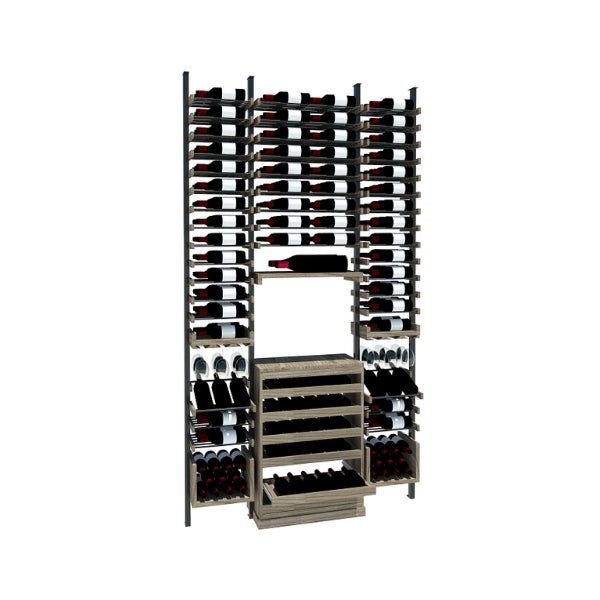
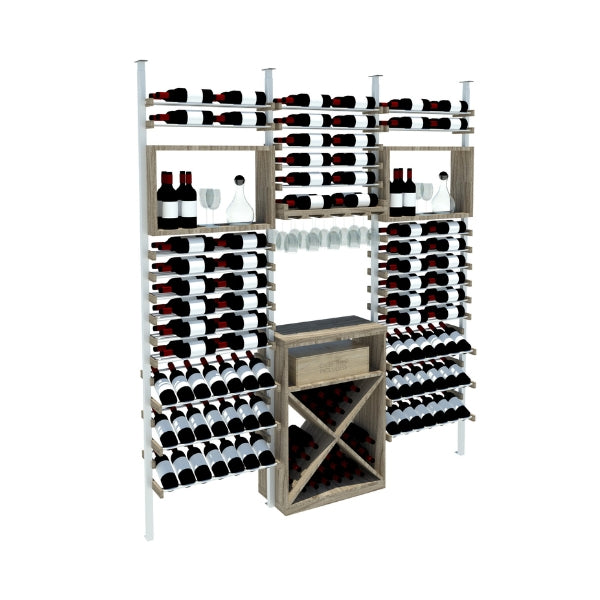
See how our garage wine cellars transform underused space into controlled, architecturally integrated storage environments with long-lasting performance.
Garage Wine Storage Cellars
A well-planned garage wine storage environment allows architects and builders to reclaim underused square footage while delivering true long-term cellaring conditions. A garage wine cellar differs from casual storage by treating the space as part of the home’s architectural envelope rather than an auxiliary zone. Proper insulation and vapor control, along with disciplined layout planning, allow a wine cellar in the garage to perform as reliably as one placed in a basement or interior room.
For residential projects where interior space is at a premium, proper wine storage creates new opportunities without altering the home’s primary floor plan. When paired with a refined garage wine cellar system, the result supports serious collections while maintaining clean sightlines, organized bottle access, and a polished presentation suited to luxury homes.
Storing wine in the garage requires careful attention to environmental stability. Temperature swings, humidity loss, and air infiltration pose risks if the space is untreated. Professional-grade garage wine storage begins with thermal separation from the exterior and a fully sealed wall and ceiling assembly, with airflow carefully managed.
Wine should remain within 50–60°F and 50–70% relative humidity to protect cork integrity and aging potential. Orientation matters as well—horizontal racking keeps corks hydrated, while thoughtful aisle spacing helps reduce vibration transfer from doors or mechanical equipment.
For architects and designers, planning garage wine cellar racks early ensures structural support, proper clearances, and compatibility with wine cooling systems specified later in the build.
Nuestro proceso de diseño es libre de estrés desde el principio. Tiene la opción de llamarnos, programar una reunión o enviar una solicitud de diseño en el formulario anterior para comenzar.
2
Personaliza tu diseño
Personalice su vinoteca a su estilo único con nuestras opciones de materiales premium. Elija entre acabados metálicos anodizados en plata, negro o dorado, y una hermosa selección de maderas, como nogal, caoba sapeli y roble blanco.
3
Sea creativo con opciones de visualización únicas
Las colecciones Millesime™ y GrandCellar™ se integran a la perfección, permitiéndole diseñar una exhibición personalizada para vinos y licores que se adapte perfectamente a su espacio. Elija entre exhibidores con etiquetas, módulos de almacenamiento de madera de profundidad completa y otras opciones de almacenamiento únicas para crear una exhibición que refleje su estilo personal.
4
Diseño y revisión
Trabajamos en estrecha colaboración con usted para diseñar su bodega de vinos y garantizar que el diseño se adapte perfectamente a sus necesidades de almacenamiento. Una vez que se delinea el espacio y se solicita el diseño inicial, le proporcionamos una representación en color 3D gratuita para que la revise y realice las modificaciones que desee.
5
Construir y enviar
Una vez que hayamos construido su bodega de vinos personalizada, se la enviaremos rápidamente para su instalación.
Personalizado desde el principio. Contáctanos y descubre todas nuestras posibilidades hoy mismo.
How to Convert a Garage Into a Wine Cellar
Converting a garage into a wine cellar starts with rethinking the space as conditioned, protected storage. Walls and ceilings must be insulated and sealed, with doors and vapor barriers detailed to support stable conditions.
Once the envelope is resolved, layout planning defines how wine storage units for garages will align with door tracks and service access, while respecting ceiling height. Structural blocking should be coordinated early to support wall-mounted or floor-to-ceiling garage wine cellar racks.
Electrical planning follows, accommodating ambient lighting and dedicated circuits for wine cooling systems. For builders, sequencing matters—finishes, racking, and cooling should install after the space achieves stable conditions to avoid rework or performance issues.
Garage environments offer surprising creative freedom when treated with the same design rigor as interior spaces. Garage wine displays can be restrained or expressive, depending on how the collection is meant to read within the home.
Minimalist metal walls
Millesime™ Streamline racks create clean, label-forward presentations that suit contemporary and modern garages with limited wall depth.
Traditional wood installations
The GrandCellar™ Collection brings structure and rhythm to traditional wine cellars, transforming a drab zone into a refined extension of the home.
GrandMillesime displays combine wood and metal to strike a balance between modern precision and classic depth for luxury residences.
Wine Cellar Design Photo Gallery
Garage Wine Cellar Design Services
We approach garage wine storage as a design problem first, not a product swap. Our team develops custom layouts shaped by the garage’s dimensions and construction constraints, then scaled to the client’s collection. Each garage wine cellar system is modular, allowing expansion over time while maintaining visual consistency.
We specify wood and metal solutions that complement modern, contemporary, or traditional interiors, and we coordinate racking layouts with wine cooling systems selected for residential use.
Through our design process, architects and contractors receive detailed drawings and installation guidance—making the transition from ordinary space to luxury garage wine cellar both predictable and precise.
It can be—provided the environment is controlled. In an unconditioned garage, daily temperature swings and low humidity are the biggest threats to cork health and long-term aging.
For projects that call for garage wine storage, treat the space like a small building envelope inside the home: insulated walls and ceiling, air-sealed penetrations, and a properly detailed vapor barrier. From a planning standpoint, it helps to locate the wine cellar away from exterior-facing doors and sun exposure, while limiting nearby heat sources.
When those fundamentals are handled correctly, a wine cellar in the garage can perform like any interior cellar, while giving the home a highly efficient storage footprint.
Is it safe to store alcohol in the garage?
Yes, but safety hinges on separation and stability. High-proof spirits are flammable, so they should never be stored beside fuels, solvents, paints, or workshop chemicals that can off-gas or introduce ignition risks. Wine also absorbs odors more easily than many people expect, so dedicated enclosure and clean airflow matter for both quality and client satisfaction.
For builders, that translates into a sealed room, non-absorptive finishes where appropriate, and clear instructions for what cannot be stored nearby. A well-designed garage wine cellar system creates a protected zone that supports both collection care and safe household use.
How do you build a garage wine cellar?
Start with the shell. Insulate and air-seal the room thoroughly, then confirm vapor control details before closing walls. Next, map circulation and service access, with bottle count defined early, so your garage wine shelves and racks align with door tracks and the wall structure behind them. Coordinate electrical early for dedicated circuits and control placement.
After the envelope is complete, install cooling and confirm the room reaches stable setpoints before final racking goes in. This sequencing reduces callbacks and helps the finished garage wine storage space look intentional rather than retrofitted.
Can you store wine in a garage without a cellar?
For short-term holding, yes—using insulated wine storage units for garages or cabinet-style solutions. These can be a good fit for a small collection, overflow bottles, or homes where a full build-out is not part of the scope.
That said, storing wine in the garage without a conditioned enclosure rarely supports proper aging. Units struggle when the surrounding environment is too hot or too cold, and they cannot address humidity across the broader storage area. For clients investing in a serious collection, a high-quality wine cellar offers far more dependable performance.
Do I need a wine cooling system for a garage wine cellar?
In most residential builds, yes. Garages typically experience larger thermal swings than interior rooms, even when insulated. Wine cooling systems allow you to hold cellar temperatures consistently and manage humidity so corks remain sound. The right specification depends on room size, insulation levels, door sealing, and heat load from adjacent spaces.
We coordinate racking layouts with the mechanical plan so the cooling approach supports the display aesthetic—modern or traditional, wood or metal, minimalist or more layered—without sacrificing performance.
Elegir una selección resulta en la actualización de toda la página.